
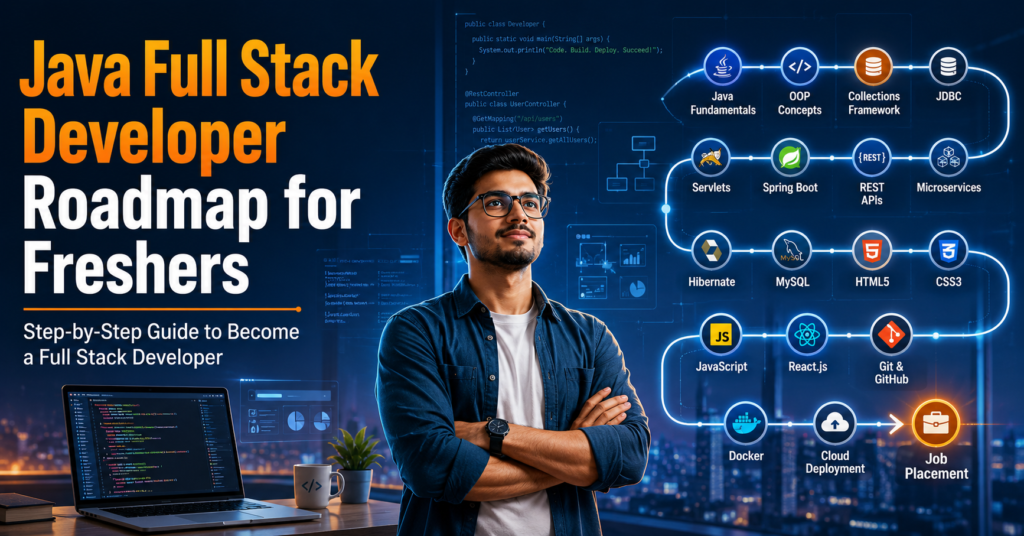
If you’re planning to start a career in software development, becoming a Java Full Stack Developer is one of the smartest choices today. Companies need developers who can build both the front end and back end of applications, making full stack professionals highly valuable.
Many students and fresh graduates searching for Java classes in Ahmedabad want to know exactly what skills they should learn and in what order. This roadmap will help you understand the complete learning path and how to build job-ready skills step by step.
Whether you’re a student, fresher, or career switcher, this guide will help you create a clear plan to become a Java Full Stack Developer.
What Is a Java Full Stack Developer?
A Java Full Stack Developer works on both the client side and server side of web applications.
They typically work with:
- Front-end technologies like HTML, CSS, JavaScript, and React
- Back-end technologies like Java, Spring Boot, and REST APIs
- Databases such as MySQL or PostgreSQL
- Version control tools like Git
- Deployment and cloud platforms
A full stack developer understands the complete application development process from user interface design to database management.
Java Full Stack Developer Roadmap for Freshers
1. Start with Core Java Fundamentals
Java is the foundation of your full stack journey.
Focus on learning:
- Variables and data types
- Operators
- Conditional statements
- Loops
- Arrays
- Methods
- Object-Oriented Programming (OOP)
- Exception handling
- Collections Framework
- Multithreading basics
Strong Java fundamentals make advanced topics much easier to understand.
Students enrolled in Java training in Ahmedabad should spend adequate time mastering these concepts before moving to frameworks.
2. Learn Front-End Development
A full stack developer must know how websites look and function on the user’s screen.
Start with:
HTML
Learn how to create webpage structures.
CSS
Understand styling, layouts, responsive design, and Flexbox.
JavaScript
Learn:
- Variables
- Functions
- DOM Manipulation
- Events
- ES6 Features
- Async Programming
After mastering JavaScript basics, move to React.js, one of the most widely used front-end libraries.
3. Learn Database Management
Almost every application stores data.
Start with MySQL and understand:
- Database design
- Tables
- Primary keys
- Foreign keys
- SQL queries
- Joins
- Indexing
Practice creating databases and writing queries regularly.
4. Master Java Back-End Development
Once your Java basics are strong, start learning enterprise-level development.
Key technologies include:
JDBC
Connect Java applications with databases.
Servlets and JSP
Understand how web applications work behind the scenes.
Spring Framework
Learn:
- Spring Core
- Dependency Injection
- Spring MVC
Spring Boot
Spring Boot is a must-have skill for modern Java developers.
Focus on:
- REST API Development
- Security
- Data Access
- Project Structure
Most companies hiring Java developers expect Spring Boot knowledge.
5. Learn Git and GitHub
Version control is an essential skill.
Understand:
- Repositories
- Commits
- Branches
- Merging
- Pull Requests
Employers often review GitHub profiles before scheduling interviews.
6. Understand REST APIs
Modern applications communicate through APIs.
Learn:
- HTTP Methods
- JSON
- API Requests and Responses
- Authentication Basics
Build simple APIs using Spring Boot and connect them with front-end applications.
7. Learn Testing Fundamentals
Testing helps ensure applications work correctly.
Start with:
- JUnit
- Unit Testing Basics
- Test Cases
Many development teams consider testing knowledge a valuable advantage.
8. Build Real-World Projects
Projects demonstrate practical skills better than certificates.
Create projects such as:
- Student Management System
- Online Shopping Website
- Employee Management System
- Library Management Application
- Task Tracking Application
Real projects help you understand how different technologies work together.
Essential Skills Every Java Full Stack Developer Should Have
Technical skills are important, but employers also value:
- Problem-solving ability
- Communication skills
- Team collaboration
- Logical thinking
- Time management
- Continuous learning mindset
Technology changes regularly, so learning should never stop.
Common Mistakes Freshers Should Avoid
Many beginners slow down their progress by making avoidable mistakes.
Avoid:
- Skipping Java fundamentals
- Learning too many technologies at once
- Ignoring project development
- Not practicing coding regularly
- Avoiding Git and GitHub
- Focusing only on theory
Consistency matters more than speed.
Why Join Java Classes in Ahmedabad?
Learning through structured training can save months of confusion.
Professional Java classes in Ahmedabad typically provide:
- Industry-focused curriculum
- Experienced trainers
- Practical assignments
- Project-based learning
- Placement support
- Interview preparation
A guided learning environment helps students stay focused and accountable.
How to Choose the Right Java Training Institute
Before enrolling, check:
- Trainer experience
- Course curriculum
- Hands-on projects
- Student reviews
- Placement assistance
- Industry-relevant technologies
A reputable IT training institute in Ahmedabad should focus on practical learning rather than only theoretical concepts.
You can also review previous student projects and placement records before making a decision.
Career Opportunities After Java Full Stack Training
After completing your learning journey, you can apply for roles such as:
- Java Developer
- Full Stack Developer
- Software Engineer
- Backend Developer
- Web Application Developer
- Application Support Engineer
As experience grows, opportunities and salary packages improve significantly.
Expert Insight
One pattern seen among successful Java developers is consistent project building. Students who create and deploy real applications often perform better in interviews than those who only complete theoretical coursework. Recruiters frequently look for practical problem-solving skills rather than just certifications.
FAQs
Which are the best Java classes in Ahmedabad for freshers?
The best training programs focus on Core Java, Spring Boot, React, databases, projects, and placement support. Look for institutes that provide hands-on learning and real-world projects.
How long does it take to become a Java Full Stack Developer?
Most beginners can become job-ready within 6 to 12 months with consistent practice and project work.
Is Java Full Stack Development a good career in 2026?
Yes. Java continues to be widely used in enterprise applications, banking systems, e-commerce platforms, and large-scale software development projects.
What is covered in Java training in Ahmedabad?
Most programs include Core Java, Advanced Java, Spring Boot, React, databases, Git, APIs, testing, and project development.
Can I join Java classes in Ahmedabad without coding experience?
Yes. Many beginner-friendly programs start from the fundamentals and gradually move toward advanced concepts.
Conclusion
The path to becoming a Java Full Stack Developer is straightforward when you follow a structured roadmap. Start with Core Java, learn front-end development, understand databases, master Spring Boot, build projects, and practice consistently.
If you’re serious about starting a software development career, enrolling in professional Java training in Ahmedabad can help you gain practical skills, industry exposure, and job-ready confidence.
Ready to start your journey? Explore our Java Full Stack training program today and take the first step toward a successful IT career.